
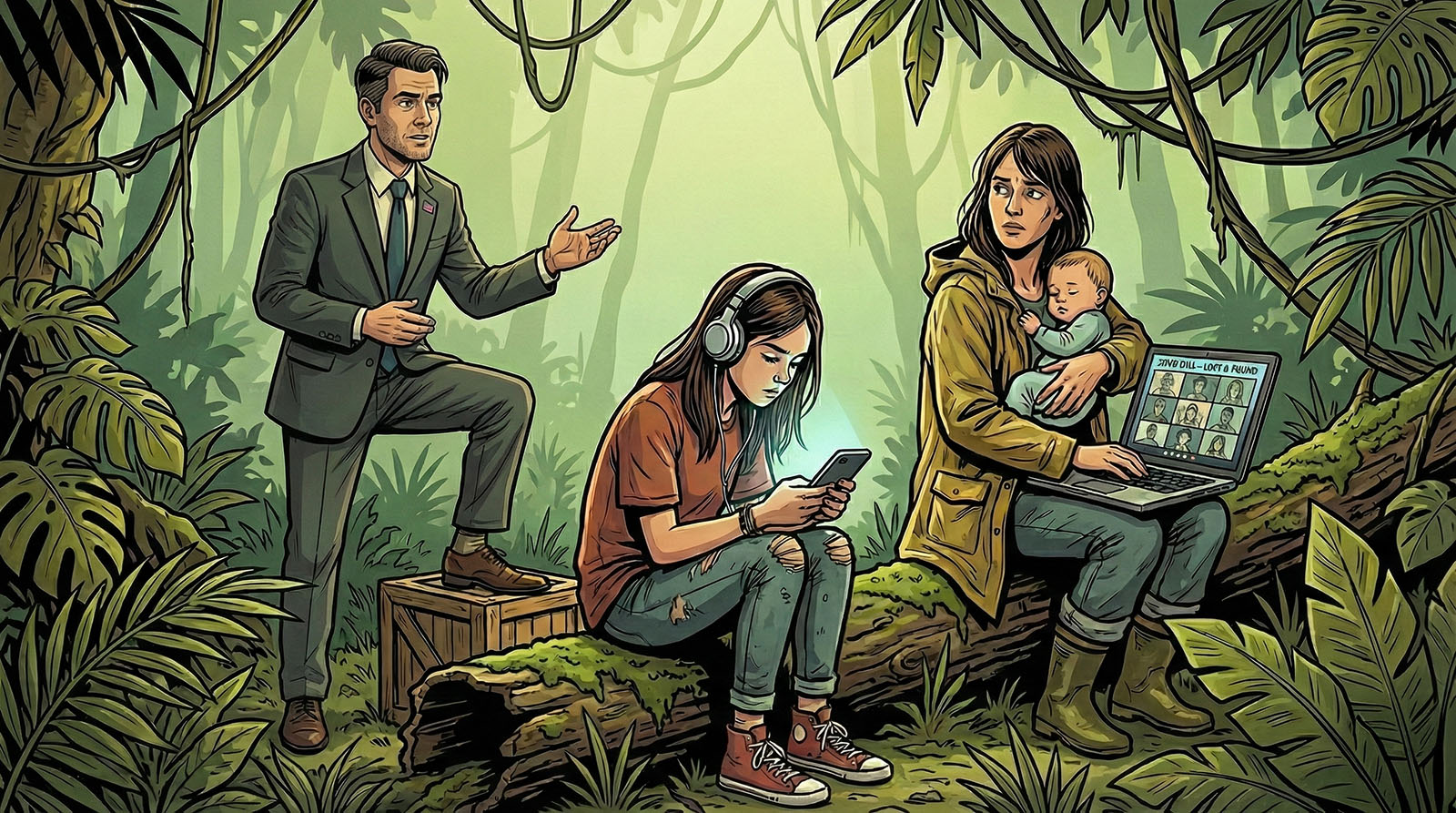
Something feels off.
Across dinner tables, social feeds, and workplace conversations, there is a low-grade anxiety humming beneath daily life that is growing louder by the minute. People work harder yet feel less secure. Young adults delay milestones their parents once assumed were inevitable. Families sense that stability is fragile. Communities feel thinner, more transactional, less anchored.
This unease is often explained as the result of bad actors, bad policies, or bad luck. But perhaps the problem runs deeper. Perhaps we didn’t break the system. Perhaps we simply drifted away from the ideas that made it work.
Human societies are not infinitely malleable. Across centuries and cultures, certain patterns repeat themselves. Some arrangements reliably produce stability, opportunity, and cooperation. Others reliably generate stagnation, dependency, and conflict. These outcomes are not ideological guesses; they are empirical facts, observable in history and measurable in real lives.
When people are free to create, exchange, and build, prosperity follows. When rules are predictable and applied evenly, trust grows. When individuals are treated as responsible agents rather than passive subjects, families and communities strengthen. These are not abstract theories. They are ideas tested repeatedly, across time, under pressure—and they work.
Yet over the last several decades, we have increasingly treated these principles as optional, outdated, or even dangerous. We have experimented with replacing responsibility with management, incentives with control, and organic social bonds with centralized solutions. We told ourselves this would be more compassionate, more equitable, more modern.
The results are mixed at best.
Economic anxiety has risen even during periods of growth. Opportunity feels narrower, not wider. Social trust has eroded. Institutions that once commanded confidence now inspire skepticism. People sense—often without being able to articulate it—that something essential has been misplaced.
This is not an argument for nostalgia or a return to some imagined golden age. The past was imperfect and unfinished. But it is a mistake to assume that because an idea is old, it is obsolete. Gravity is old. So is cause and effect.
Flourishing societies are built, not wished into existence. They depend on clear rules, meaningful ownership, earned trust, and the freedom to fail and try again. They require a belief that people, given room and responsibility, are capable of more than compliance. These ideas do not constrain human potential; they unlock it.
The good news is this: getting lost is not the same as being doomed.
Paths can be rediscovered. Bearings can be reset. The anxiety so many feel may be less a sign of collapse than a signal—a quiet reminder that we have wandered off course.
Re-centering on proven principles does not require uniformity of thought or culture. It requires humility: the willingness to admit that some experiments did not deliver what they promised, and that wisdom accumulated over generations is worth revisiting. It requires curiosity instead of outrage, and seriousness instead of slogans.
Most of all, it requires hope grounded in reality. Not the hope that everything will fix itself, but the hope that we can choose better—because we know what better looks like.
Perhaps we lost our way. But the path to flourishing was never erased. It is still there, waiting for those ready to get back on track.